Napoleon, Sovereign, Krugerrand: The Most Common Gold Coins
By Maxence Roux· Published on · Updated on
Have you inherited gold coins, or found some at the back of a drawer? There is a good chance they are among the coins presented here. For each one, you will find its weight, fineness and pure gold content: the three pieces of information needed to estimate its value.
Have you inherited gold coins, or found some at the back of a drawer? There is a good chance they are among the coins presented here. For each one, you will find its weight, fineness and pure gold content: the three pieces of information needed to estimate its value.
Indicative values and examples only. This content is for information and does not constitute investment advice.
Summary table
| Coin | Country | Total weight | Fineness | Pure gold content |
|---|---|---|---|---|
| 1 ounce American Eagle | United States | 33.93 g | 916.7 ‰ | 31.10 g |
| 1 ounce Maple Leaf | Canada | 31.10 g | 999.9 ‰ | 31.10 g |
| 1 ounce Krugerrand | South Africa | 33.93 g | 916.7 ‰ | 31.10 g |
| 1 ounce Philharmonic | Austria | 31.10 g | 999.9 ‰ | 31.10 g |
| Sovereign | United Kingdom | 7.99 g | 916.7 ‰ | 7.32 g |
| Napoleon 20 Franc | France | 6.45 g | 900 ‰ | 5.81 g |
| 50 pesos | Mexico | 41.67 g | 900 ‰ | 37.50 g |
The values are rounded. One troy ounce equals 31.1035 grams.
One-ounce bullion coins
Several countries mint coins containing exactly one troy ounce of pure gold (31.10 grams). They are highly sought after by people who want to hold physical gold:
- The American Eagle (United States), minted since 1986: 22K gold, with one troy ounce of pure gold in a 33.93 g coin.
- The Maple Leaf (Canada), minted since 1979: in almost pure gold (999.9 fineness), it weighs exactly one ounce.
- The Krugerrand (South Africa), minted since 1967: in 22 karat gold, it weighs 33.93 grams for one ounce of pure gold. The added metal gives it a slightly orange hue.
- The Vienna Philharmonic (Austria), minted since 1989: also at 999.9 fineness.
These coins also come in smaller sizes (half-ounce, quarter-ounce and tenth-ounce).
The Napoleon 20 Franc (France)
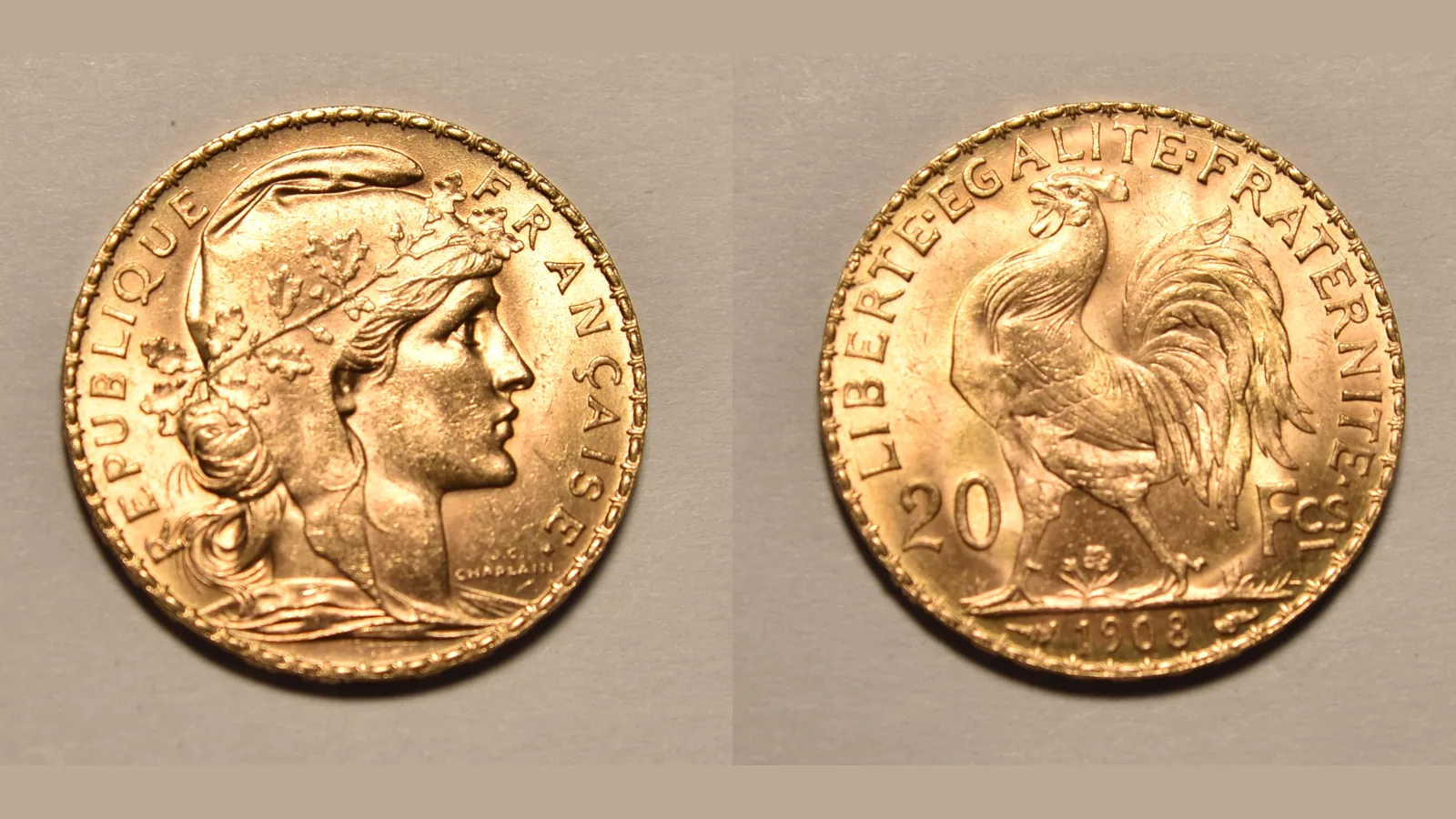
It is the most common gold coin in France. The term “Napoleon” actually refers to all French 20-franc gold coins minted in the 19th and early 20th centuries: those depicting Napoleon I or Napoleon III, as well as the Genius and Marianne with rooster designs. All share the same specifications: 6.45 grams of gold at 900 fineness, or approximately 5.81 grams of pure gold.
To learn more and calculate its value, visit our dedicated Napoleon 20 Franc page. For its value at today's gold price, read “How Much Is a 20 Franc Napoleon Gold Coin Worth Today?”.
The Sovereign (United Kingdom)
Minted since 1817, the British Sovereign is one of the most widely traded gold coins in the world. It weighs 7.99 grams in 22 karat gold (916.7 fineness) and contains approximately 7.32 grams of pure gold. It bears portraits of different British monarchs.
Visit our dedicated Sovereign page.
The 50 pesos (Mexico)
First minted in 1921, this large Mexican coin contains 37.5 grams of pure gold, more than an ounce. It weighs 41.67 grams at 900 fineness.
How to estimate a coin's metal value
Metal value corresponds to the pure gold contained in the coin:
Metal value = pure gold content (in grams) × pure gold price per gram
Example using a hypothetical price of $100 per gram of pure gold (an example figure only):
| Coin | Pure gold content | Metal value (example price) |
|---|---|---|
| Napoleon 20 Franc | 5.81 g | $581 |
| Sovereign | 7.32 g | $732 |
| 1 ounce Krugerrand | 31.10 g | $3,110 |
For a calculation using real prices, updated throughout the day, use our gold calculator or check the metal prices.
Metal value, premium and market price
A gold coin's price is not always equal to its metal value. Distinguish between:
- metal value: the value of the pure gold content, calculated above;
- the premium: the difference between market price and metal value. Common, highly demanded coins often have a premium that varies with supply and demand;
- collector value: certain rare years or coins in excellent condition attract collectors and can be worth significantly more than their gold weight.
For an old or unusual coin, ask a numismatist's opinion before selling it.
How can you recognize a genuine gold coin?
A few simple checks can help identify the crudest counterfeits:
- weight: weigh the coin on a precision scale and compare it with the reference weight in the table;
- diameter and thickness: a counterfeit coin of the same weight is often thicker or wider;
- appearance: sharp engraving, a regular edge and no traces of casting.
These checks do not replace a professional assessment using appropriate verification tools.
Take care of your coins
- Do not clean them: cleaning can cause a large loss of collector value.
- Handle them by the edge to avoid fingerprints.
- Store them in suitable cases or capsules, away from moisture.
- Keep invoices and certificates, which help prove their origin when reselling.
Track your gold coins with Metalstat
Record your American Eagles, Maple Leafs, Krugerrands, Philharmonics, Sovereigns, and Napoleons in Metalstat. Their reference weight and fineness help you enter them quickly, and Metalstat calculates their indicative metal value using real prices, updated throughout the day. You can track your collection over time, coin by coin.
Notes for readers worldwide
Examples use US dollars. The formulas work in any currency, provided purchase costs, metal quotes, and sale proceeds use the same currency. Metalstat lets you display values in USD, EUR, MAD, GBP, or CHF; not every currency is available in the app.
Gold prices are often quoted per troy ounce. One troy ounce is approximately 31.1035 g: divide the price per troy ounce by 31.1035 to obtain the price per gram, then apply fineness and quantity. Do not use an ordinary ounce.
Gold purity is expressed in karats (K). 14K is common in the United States, 18K is widely used in Europe, and 22K–24K is popular in parts of Asia and the Middle East; practices vary by market and product. International marks include “750” or “18K” and “585” or “14K”. An eagle's head is a French hallmark example, not a worldwide requirement, and a mark alone does not prove authenticity.
Tax, identification, payment, and selling rules vary by country and, in the United States, by state. Check with your local tax administration and other relevant authorities, or consult a qualified local professional. Do not assume a rule from another country applies to your sale.
Frequently asked questions
How many grams of pure gold does a Napoleon contain? A Napoleon 20 Franc contains approximately 5.81 grams of pure gold, with a total weight of 6.45 grams at 900 fineness.
What is the difference between a Krugerrand and a Maple Leaf? Both contain one ounce of pure gold. The Krugerrand is 22 karat gold, making it heavier (33.93 g) and more resistant to scratches. The Maple Leaf is almost pure gold (999.9 fineness) and weighs 31.10 g.
Is my coin worth more than its gold weight? It may be if it is rare, from a sought-after year or in excellent condition. Common coins generally trade around their metal value with a variable premium. Consult a numismatist for a reliable estimate.
How can I tell whether my gold coin is genuine? Compare its weight, diameter and thickness with reference values. If in doubt, have a professional check it.
Should you clean an old gold coin? No. Cleaning can damage the surface and significantly reduce its collector value.
In summary
The American Eagle, Maple Leaf, Krugerrand, and Philharmonic are major one-ounce bullion coins, while the Sovereign and Napoleon are historic European references. To estimate their value, multiply their pure gold content by the day's price and remember the premium and any collector value. To track your coins easily, record them in Metalstat.
Track your gold and silver portfolio with Metalstat
Keep your objects and purchase records together, with clearly identified indicative metal estimates.
Create your account